
STORY STUDY - MEDIUM: FILM - “Inside Out”

What if the current emotion you ever had at any given moment was only happening because the personified version of that emotion was controlling your actions?
Directed by Pete Doctor, Co-directed by Ronnie del Carmen, screenplay by Doctor, Meg LaFauve, and Josh Cooley, and story by Doctor and del Carmen, Inside Out tells the story the main five emotions, Joy, Sadness, Anger, Disgust, and Fear who are stationed at Headquarters to control the life of 11-year-old girl Riley, who has just moved from Minnesota to San Francisco, Califonia.

Joy takes pride in her job, thinking that everything can be solved through happiness. Who she considers a nuisance is Sadness. While she knows the importance of the other emotions in Riley’s life, she believes that Sadness can only cause negativity in Riley’s life, which is never a good thing.
One day, they discover that Riley’s memories can suddenly change into a different context, such as a traditionally happy memory can suddenly be turned into a depressing one if Sadness touches it, which indeed happens. Because of Sadness’ actions, Joy tries to fix the situation, which causes the both of them to get sucked out of their console room, and become lost in Riley’s long-term memory.

Since Joy, the leader and dominant emotion of Riley is gone, Fear, Anger, and Disgust has no choice but to take control of Riley, buying enough time for Joy and Sadness to get back before Riley becomes a complete wreck.

Along the way, Joy realizes the importance of Sadness’ existence, both the character and the emotion.

Describing the plot is very difficult, since there is a reason why Inside Out works so well as a film: the audience can understand how this world (or at least, how every person) operates in this world without much verbal exposition. I haven’t even gotten to the importance of the orbs, which are memories, and the personality islands that make up Riley as a person.
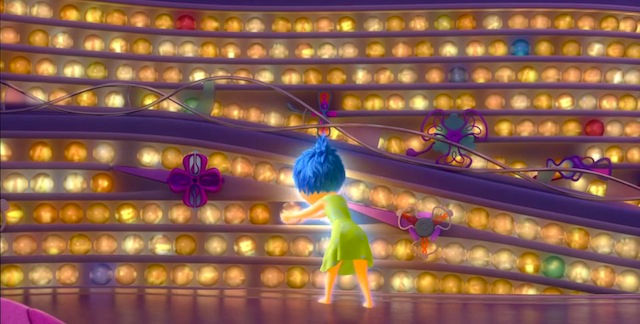

My interpretation of the film is that what Riley goes through is something that everyone has gone through. Much like how a film is structured, Riley goes through her early childhood being happy in her hometown, playing her favorite sport, and having great friends until suddenly something that turns her world upside-down: moving to a different state. In reality, there’s going to be a lot of thoughts and emotions going through one’s head; disbelief, sadness, maybe some anger, barely any joy. In context of the story, Riley doesn’t go through those emotions until Joy is suddenly not in control anymore.
Anger, Fear, and Disgust try to replicate Joy’s work, but Riley just ends up exhibiting a mixture of awkwardness and frustration, which is something I’m sure everyone has gone through at least once in their childhood.
To sum it up, I felt that Inside Out wanted to give its interpretation or analogy of what happens when every person comes-of-age: Joy is lost somewhere in our subconscious, and the other emotions take control of us. However, through determination, happiness will come back.

I absolutely love the construction of this world, and how it operates. The idea of having memories becoming orbs that goes into our long-term memory every night when we go to sleep is clever. However, the core memories, the moments that come to define who we are as an individual, that stays in our brain, much easier to access.

Pixar films on the surface knows when to be funny and entertaining, but when they hit the emotional, dramatic scenes, it suddenly becomes on par with the best of any heavy drama movies, and Inside Out, I felt, outdid itself with its climactic scene. Without giving away too much, I ended up crying when Riley breaks down in front of her parents, and it’s all because Joy finally realizes the importance of Sadness: her ability to create grief, and how it can bring the people in our lives together to comfort each other. Kaitlyn Dias does an amazing job acting in this scene with the right emotion and tone of voice.

On a similar note, Joy’s breakdown when she thinks her situation is hopeless is equally heartbreaking. The scene where she’s crying over Riley’s past memories, essentially her work, while its being faded away and forgotten is well animated and especially well-acted by Amy Poehler.

Sure, this doesn’t make sense since she is supposed to be Joy and is only supposed to experience Joy, but that doesn’t make for good drama. Honestly, any of the problems that people have with this film can be very nitpicky. It all comes down to the characters and how much they would believably react to a situation. If you find their personality annoying or unbearable, that really depends on who the individual viewer is. It’s why there is no such thing as a perfect movie: because every person is different, therefore they will see and react to something the others didn’t.
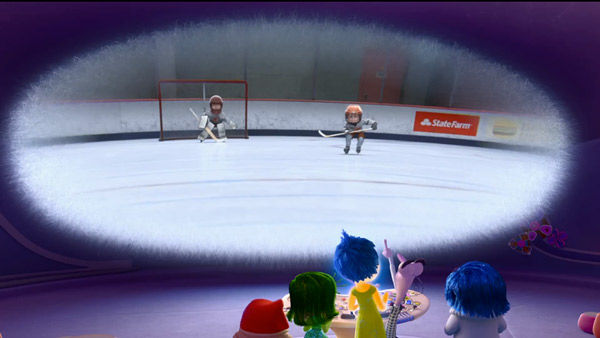
I absolutely love Inside Out. It gives us the lesson that something that is perceived as unnecessary in our life is actually very important and useful, which is also something we should tell ourselves when we feel depressed. But hey, that’s why Joy is there to bring us back up.
Create a core memory by checking it out.


Comments