
STORY STUDY - MEDIUM: FILM - “Double Indemnity”

“I didn’t get the money… and I didn’t get the woman.”
I’m breaking my “spoilers” warning here because, well, the movie tells you this right from the beginning. But come on: you can’t help but wonder what happened when a guy who’s been shot entered, and told you this.

Directed by Billy Wilder, co-written by Wilder and Philip Marlowe creator, Raymond Chandler, and based on the novel of the same name by James M. Cain, Double Indemnity is a 1944 film about insurance salesman Walter Neff who, on one of his routes, meets Phyllis Dietrichson. Understanding what Neff does, the femme fatale takes advantage of Neff being smitten with her, seducing and convincing him to take out an accident policy on Phyllis’ husband, and then they kill him to get the money. “Double indemnity” refers to a clause in the policy that doubles the payout for accidents “the kind that almost never happens.”

Neff’s colleague and friend, Barton Keyes, is suspicious of the circumstances of Mr. Dietrichson’s death, and correctly assumes he was murdered by Phyllis and a “somebody else.”
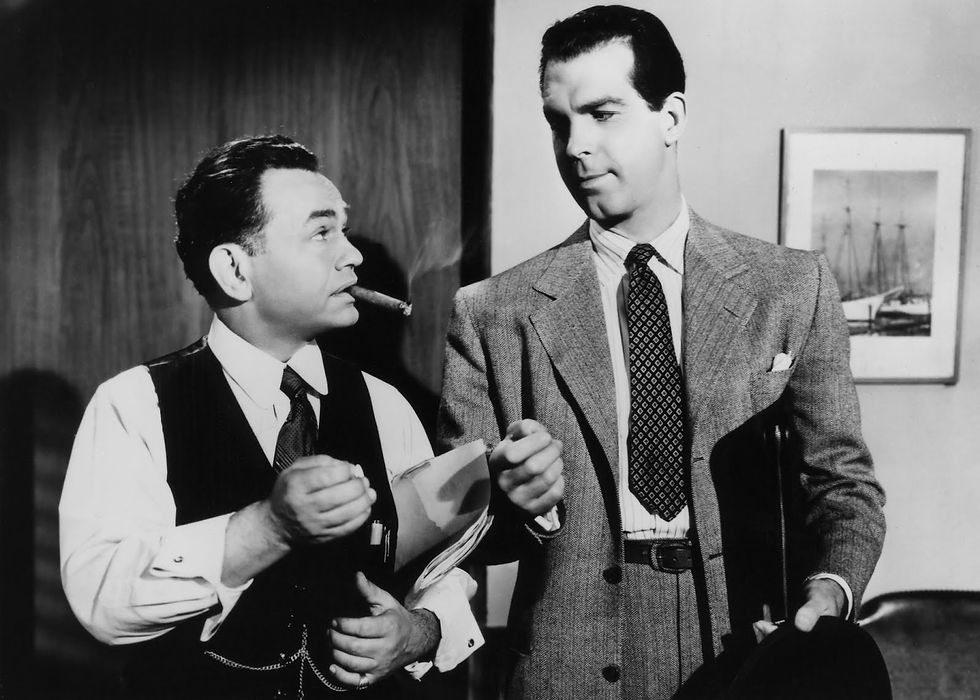
Making matters worse is Dietrichson’s daughter, Lola, who knows something about Phyllis, and tells Neff, the only person she can go for comfort, she’s planning on telling the police. Neff is worried that this will lead them to him, so he comforts and continues seeing her so she won’t carry out her plan. Neff’s continued time with her fills him with guilt.

The film is told mainly in flashback with the occasional present day scene with Neff recounting events into a dictating machine in his office. The voice-over employed throughout the film is him recounting into the machine.

Double Indemnity is considered to be the first example of “film noir,” the popular genre that features crime stories involving cynical characters motivated by love and lust. Typical protagonists are detectives (private or policemen) trying to solve a crime, but here, it’s a normal man being driven into committing a crime for financial and romantic gain.
The film relies on its dialogue and suspense, both of which still resonate today. After the murder is committed, there are instances, two specifically, where maybe Neff will be found out. You just want to know how far this plot plays out, and where it will go.
What bothers me is that Walter Neff doesn’t seem like someone who can be easily swayed into committing something like murder.
When he is introduced, he seems content with his life as a salesman. He even says so himself to Keyes at one point. Even when he flirts with Phyllis, he is playful and smiling. In the middle of the film, he does admit that he wonders how he himself can rip off the insurance company, since he knows how they work, what questions they would ask, what they would look for in phony claims, etc. However, I expected something less lethal, like burning his car, like one character apparently does in the film.
But for an ordinary man to commit murder? She would have to be one, sexy woman for that to happen.
Regardless, Double Indemnity is still a suspenseful tale that is, as Keyes would say, “... packed with drama with twisted hopes and crooked dreams.” It features memorable dialogue and a beautiful, dark atmosphere. It’s one of the films that defined Billy Wilder’s career, and is taught in film classes to demonstrate “film noir” techniques.
Check it out and see for yourself.


Comments